A home business website is usually built twice: once badly, in a weekend, and once properly two years later after the first one stopped bringing anything in. The second build is the expensive one, because by then the business depends on it. Short-term rental, consulting practice, trade working out of a garage: the questions are the same. What does it cost to run, what platform fits, and what rules apply once money changes hands. The timing matters this year, because Airbnb just finished rewriting the arithmetic that decides whether a direct booking site is worth building at all.
What a home business website costs to run
The subscription is the visible cost and rarely the largest. A mainstream builder runs $16 to $36 a month depending on plan and billing cycle, a domain costs $15 to $25 a year after the first-year discount, and SSL is included everywhere worth using. Self-hosted WordPress trades the subscription for hosting at $5 to $30 a month plus a theme, plus the time to keep plugins patched.
Payment processing is the forgotten line. Standard online rates sit near 2.9 percent plus 30 cents per transaction, and no plan removes it. On $40,000 of bookings that is roughly $1,200 a year, every year. Add email hosting, a scheduling tool if the builder lacks one, and photography, the highest-return spend on any home business website and the one most owners skip.
Budget $600 to $1,200 in year one self-built, or $3,000 to $8,000 designer-built. Neither figure includes the hours.
Why 2026 changed the direct booking math
Airbnb spent the last year retiring its split fee, where the host paid about 3 percent and the guest paid a separate 14 to 16.5 percent at checkout. The replacement is a single host-only fee of 15.5 percent taken from the host payout, with guests seeing no separate service fee. The migration became mandatory for remaining hosts on September 15, 2026 outside the European Economic Area, and October 13, 2026 inside the EEA and Switzerland.
Two consequences follow. The platform cost now lands on the host’s own payout instead of the guest’s checkout, which makes the comparison obvious for the first time. Against 15.5 percent, a website plus 2.9 percent processing reads very differently than it did against 3 percent.
The second is a repricing trap. To keep the same payout under a 15.5 percent deduction, the correct move is to divide the target by 0.845, not to add 15.5 percent. On a $200 target, dividing gives $236.69 and adding gives $231, which leaves about $5.69 a night on the table. Across a busy season that gap is real money, and plenty of hosts will get it wrong.
None of this means abandoning the platforms, which supply demand a new website cannot. Keep the listings, build the site for repeat guests and referrals, and run both.
Picking a platform without regretting it
For most home businesses a hosted builder is the right answer, because the alternative is becoming a part-time systems administrator. Squarespace suits design-led small sites and bundles scheduling, which covers home service businesses taking appointments. Worth knowing before committing: it was taken private by Permira in 2024 and raised prices by up to 26 percent in July 2026, with the standard plan moving from $23 to $29 a month on annual billing, so price the renewal rather than the promotional first year. Wix is the broader competitor with more built-in features and a busier interface. WordPress is the right call when the site needs to do something unusual, or when the owner already knows it.
Short-term rental hosts have a fourth option worth pricing: direct booking software that handles calendars, channel sync, and payments together. It costs more than a builder and does more.
Whatever the platform, the site has one job at the start: converting a visitor who already knows the business exists. Clear pricing, real photographs, a working phone number, and a booking path that takes under a minute. Search traffic comes later, and slower than anyone expects.
Rules that apply to a home business website
Two obligations catch home businesses by surprise, and both live on the website rather than in the business.
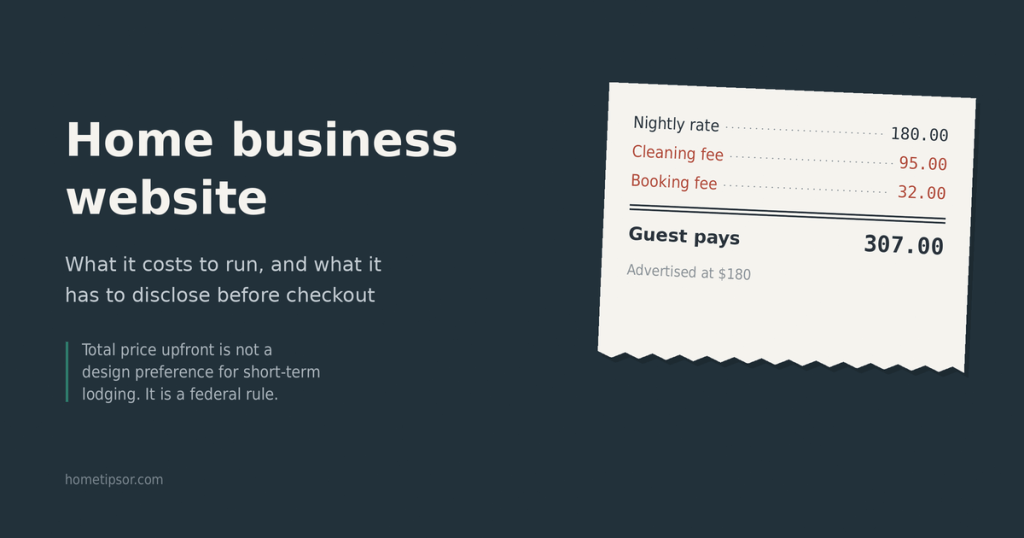
Short-term rentals are now covered by the FTC’s Rule on Unfair or Deceptive Fees, in force since May 12, 2025. It requires the total price, including every mandatory fee the business can calculate upfront, to be disclosed clearly and prominently wherever a price is advertised. The FTC’s own guidance confirms it reaches vacation rentals and home shares, and covers the operator’s own site rather than only the big platforms. It does not ban cleaning or pet fees. It bans hiding them until checkout, which is exactly what quoting a nightly rate and revealing the cleaning charge three screens later does.
Accessibility is the second. Businesses open to the public fall under Title III of the ADA. No federal regulation names a technical standard for private sites, but the Justice Department’s guidance is clear the requirement applies online, and courts have settled on WCAG 2.1 Level AA as the benchmark. More than 5,000 digital accessibility suits were filed in 2025, and small sites are targeted precisely because settling is cheaper than defending. The cheap fixes cover most of the exposure: sufficient color contrast, alt text on images, labelled form fields, and a site that works with a keyboard alone. Avoid overlay widgets that promise instant compliance. The FTC fined one such vendor $1 million in January 2025 over claims its tool did not deliver.
A home business also concentrates business data on a home network. If the same connection runs the cameras and the door lock, the smart home security basics stop being optional once guest records and payment details live behind it.
Before launch
- Register the domain in the owner’s name, not the designer’s account.
- Put the total price, including mandatory fees, on every page that quotes a price.
- Run a free accessibility checker and fix contrast, alt text, and form labels first.
- Claim and complete the Google Business Profile, which often outperforms the site for local searches.
- Set up a business email on the domain rather than a free address.
- Check the local rules, since short-term rental permits, home occupation zoning, and HOA covenants all bite before traffic does.
- Export a backup and know how to restore it.
FAQ
How much does a home business website cost?
Roughly $600 to $1,200 in the first year building it yourself, covering the builder subscription, domain, and a decent photo session. A designer-built site runs $3,000 to $8,000. Payment processing of about 2.9 percent plus 30 cents per transaction sits on top and never goes away.
Is a direct booking website worth it for a short-term rental?
The case is stronger in 2026 than it was, because Airbnb’s single 15.5 percent host fee makes the platform cost visible. Direct bookings cost roughly 3 percent in processing instead. The catch is that the platform supplies the demand, so most hosts run both and use the site for returning guests.
Do I need a privacy policy on a home business website?
If the site collects names, emails, or payments, yes. Several US states and the GDPR require disclosure of what is collected and why, and most builders include a generated policy that still needs editing to match what the site does.
Can I build the site myself?
Yes, and most owners should for the first version. Hosted builders remove the technical work, and the parts that decide whether it converts, which are photographs, pricing clarity, and a fast enquiry path, are not technical problems.