Rental bookkeeping is the part of owning property that nobody buys the property for, and it is also the part that quietly decides how much tax gets paid on it. The IRS does not ask to see a shoebox of receipts in April. It asks for numbers on Schedule E, split by property, supported by records that were created during the year rather than reconstructed after it. Most landlords are running that job themselves. The 2024 Rental Housing Finance Survey, released by the Census Bureau and HUD in February, still shows individual investors owning the largest share of one-unit rentals by a wide margin, with LLC and partnership structures gaining ground but institutions holding under 2 percent.
What rental bookkeeping has to produce
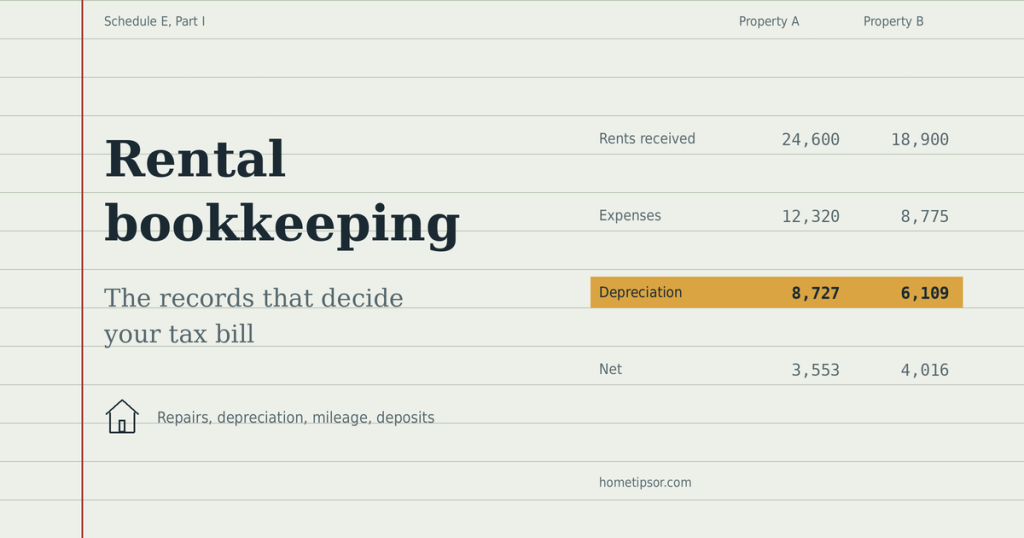
The output is Schedule E, Part I of Form 1040. Each property gets its own column: gross rents in, then deductible expenses line by line, including advertising, cleaning, insurance, management fees, mortgage interest, repairs, property taxes, utilities, and depreciation. The result is net income or loss per property.
That format works backwards into the bookkeeping. Every transaction needs two tags from the moment it happens: which property, and which Schedule E line. Books that only track a portfolio total have to be re-sorted by hand at filing time, which is where errors and missed deductions live. IRS Publication 527 is the reference document for all of it, and it is worth reading once in full rather than in fragments each April.
A few categories trip people up. Security deposits are not income in the year received if the plan is to return them, though a deposit kept for unpaid rent becomes income at that point. Tenant-paid expenses count as rental income. Mileage to and from the property is deductible, at 70 cents a mile for 2025, but only with a log kept at the time rather than an estimate made later.
The repair versus improvement line
This is where most money is won or lost. A repair keeps the property in working order and deducts in full this year. An improvement betters, restores, or adapts the property and gets capitalized, then recovered over 27.5 years. Patching a section of roof is a repair. Replacing the roof is an improvement. The tax difference on a $9,000 job between deducting now and deducting $327 a year for nearly three decades is not a rounding error.
Two safe harbors give small landlords a shortcut. The de minimis safe harbor lets anyone without audited financial statements deduct items costing $2,500 or less per invoice or item, whether or not they would otherwise count as improvements. The safe harbor for small taxpayers covers total annual spending on a building, capped at the lesser of $10,000 or 2 percent of the property’s unadjusted basis.
Both have conditions worth knowing before relying on them. Each is an annual election attached to a timely filed return, not a default. The de minimis election needs a written accounting policy in place at the start of the year, which means one dated sentence in the files, not a memory of intent. And the small taxpayer harbor is all or nothing: go a dollar over the cap on a building and the whole election fails for that building that year, sending every expense back to individual classification.
Depreciation is not optional
The most expensive rental bookkeeping mistake is skipping depreciation, usually by an owner who feels the deduction is not worth the paperwork. The tax code adjusts basis for depreciation allowed or allowable. Translated: when the property sells, the IRS reduces the cost basis by all the depreciation that could have been claimed, whether any of it was claimed or not. Skipping it does not preserve anything. It donates the deduction and then taxes the gain as though it had been taken.
The fix for years of missed depreciation is Form 3115, a change in accounting method that catches the whole amount up in one year, not a stack of amended returns. That is genuinely a job for a CPA, and one of the few tax conversations that reliably pays for itself.
Worth knowing for anything bought recently: the 100 percent bonus depreciation allowance was restored for qualified property acquired and placed in service after January 19, 2025. That does not apply to the building itself, which stays on the 27.5 year schedule, but it can apply to appliances, carpet, and similar shorter-life components, which is why cost segregation studies came back into fashion.
Separate accounts do two jobs at once
Rent flowing into a personal checking account is the root of most bad rental books, because the sorting then has to happen later, from memory, against a statement full of groceries. A dedicated account per property, or at minimum per portfolio, turns the bank feed itself into the ledger.
The same separation carries legal weight for anyone who formed a rental property LLC, since commingling funds is the most common way courts set an entity aside. One habit satisfies both the accountant and the liability structure.
Purpose-built platforms exist for this. Baselane combines landlord banking with bookkeeping that tags transactions by property and Schedule E category as they land, and generates the tax package at year end. Spreadsheets work too, particularly under about five units, and QuickBooks handles it for owners who already use it elsewhere. One caution that applies to the whole category: most of these platforms are financial technology companies rather than chartered banks, with deposits held at partner institutions, so check where the money sits and how it is insured before moving a portfolio’s cash into one.
A setup that survives review
- Open a separate account per property, plus a holding account for security deposits where state law requires one.
- Tag every transaction to a property and a Schedule E line at the time it clears.
- Photograph receipts and contractor invoices immediately, since invoice detail decides safe harbor eligibility later.
- Write the de minimis accounting policy on the first business day of the year and date it.
- Keep a contemporaneous mileage log rather than a year-end reconstruction.
- Track improvements separately and permanently, because those records matter at sale, long after the three year general retention window has passed.
- Reconcile monthly. An hour twelve times beats a lost weekend every April.
FAQ
What rental bookkeeping records does the IRS expect?
Contemporaneous ones: bank statements showing rent deposits, invoices and receipts for expenses, mileage logs, and documentation of personal versus rental days. Records assembled after the fact are weaker evidence, and in an examination the difference shows.
Do I need accounting software for one rental property?
No. A spreadsheet with property and Schedule E columns handles a single unit fine. Software earns its price somewhere around three to five properties, or sooner when multiple entities and bank accounts are involved and the reconciliation becomes the real work.
Can I deduct a new roof on a rental property?
Not in one year. A full roof replacement is an improvement, capitalized and depreciated over 27.5 years. Repairing a damaged section is a deductible repair. If the old roof came off, there is also a partial disposition election that writes off its remaining basis, but it has to be claimed on that year’s original return.
How long should rental records be kept?
Three years covers the general statute of limitations for most returns. Anything that establishes basis, which means purchase documents and every improvement invoice, should be kept for as long as the property is owned and three years past the sale.