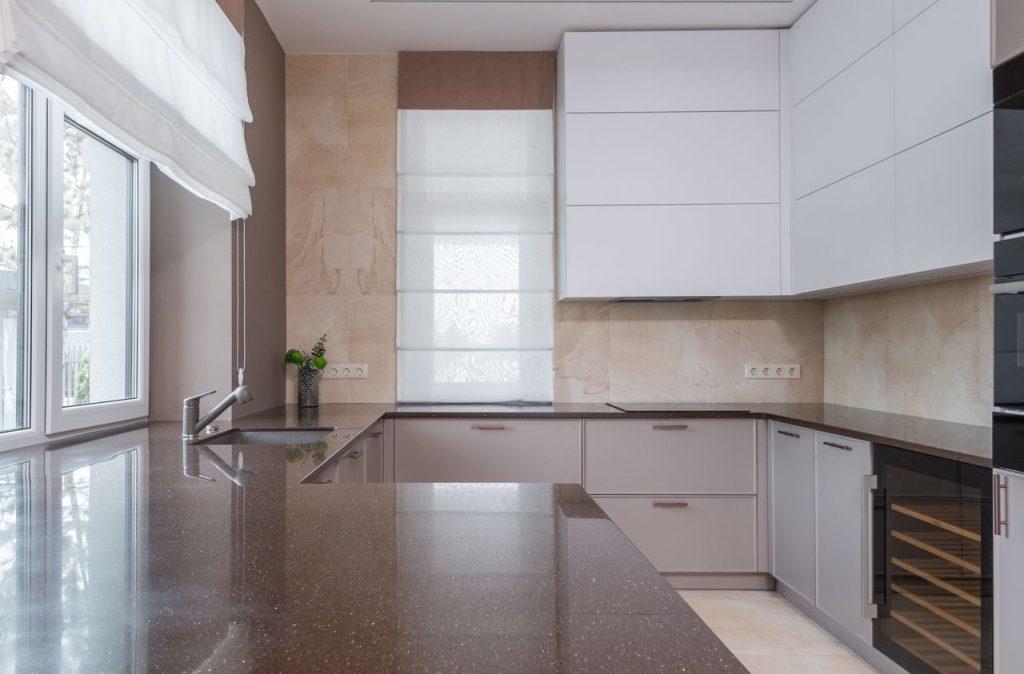
Kitchen countertop materials get chosen backwards in most projects: the slab gets picked in a showroom under good lighting, and the budget, the maintenance schedule, and the ten-year consequences get discovered later. Counters deserve more respect than that. They are the most touched surface in the house, they sit near the top of any kitchen budget behind cabinets and labor, and they are part of the reason American homeowners are on track to spend about $518 billion on improvements and repairs in 2026, a figure the Harvard Joint Center for Housing Studies expects to keep inching up even in a slow housing market. This guide covers what each surface costs installed, what it demands afterward, and one health issue the industry would rather keep out of the showroom.
How kitchen countertop materials price out in 2026
Installed prices are the only prices worth comparing, because fabrication and installation typically eat 35 to 55 percent of the total. A slab that looks affordable at the stone yard stops looking affordable after templating, cutting, edging, and setting.
Current national ranges per square foot, installed, run roughly as follows. Laminate sits at $15 to $40 and remains the only surface a patient homeowner can install without a fabricator. Solid surface, the Corian family, runs $40 to $80 and buys invisible seams and easy repairs. Butcher block lands between $40 and $100 depending on species and thickness. Granite starts around $40 for the common level-one colors and runs to $100, with exotic slabs passing $150. Quartz, the engineered blend of ground stone and resin that now outsells everything else in American kitchens, runs $50 to $120, and most projects settle between $75 and $95. Porcelain and sintered slabs run $60 to $120. Marble starts near $60 and climbs past $150 for the Calacatta look. Quartzite, the natural stone often confused with quartz, spans $70 to $150 and beyond.
Three cost traps hide inside those ranges. Stone is bought by the slab, not the finished foot, so a layout that wastes half a slab pays for the waste anyway. Edge profiles, sink cutouts, and backsplashes are quoted as extras and add $200 to $1,000 or more. And tear-out of the old counters, usually $200 to $500, appears on some quotes and not others, which makes two bids look further apart than they are.
Durability is the second price
Kitchen countertop materials charge twice: once at install, then again in upkeep, repairs, or early replacement.
Quartz earns its market share here. It is non-porous, never needs sealing, and shrugs off wine, coffee, and lemon juice. Its weakness is heat, because the resin that binds it can scorch or discolor under a pan straight off the burner, so a trivet habit is part of the purchase. Granite handles heat better than any engineered product and resists scratching, but it is porous, which means sealing on a recurring schedule and the risk of oil stains around the cooking zone when the schedule slips. Marble etches. Acids dull its polish on contact, and no sealer prevents it, so marble belongs to owners who accept patina as character rather than damage. Quartzite is harder than granite and takes heat well, but it still wants sealing, and long unsupported spans can crack without proper bracing underneath.
The budget materials have honest lifespans rather than hidden ones. Butcher block scratches and burns, and then sands back to new with an afternoon of work and a coat of oil, which no stone can claim. Laminate resists daily abuse well but cannot be repaired once water finds a seam, and 10 to 15 years is a realistic run before edges lift. Porcelain resists heat, stains, and UV almost completely, but a chipped edge is difficult to fix invisibly, and few fabricators handle the material well yet, which shows up in the quote.
The quartz dust problem the showroom skips
There is a serious issue attached to the most popular surface in the country, and it deserves plain language. Engineered quartz is typically over 90 percent crystalline silica, compared with under 45 percent in granite, according to NIOSH. When slabs are cut, ground, or polished, that silica becomes respirable dust, and breathing it causes silicosis, an irreversible lung disease. California health officials identified the first two US deaths among engineered stone fabrication workers in 2019, the case count has grown since, and Massachusetts confirmed its first case in late 2025, with its health department warning that more are expected given how long the disease takes to appear. OSHA and NIOSH issued a joint hazard alert for the countertop industry in 2026. Australia went further and banned engineered stone outright in July 2024.
The important distinction for a homeowner: an installed quartz counter is inert and poses no risk in the kitchen. The danger sits entirely in the fabrication shop, in the cutting and finishing that happens before delivery, and it lands on workers, not on the family eating breakfast. That still gives the buyer a lever. Fabricators who cut wet, use vacuum dust capture, and monitor air quality are running the controls that prevent the disease, and they will say so when asked. A shop that dodges the question about how it cuts is answering it. Several manufacturers now also sell low-silica and zero-silica engineered lines, which are worth requesting by name for anyone who wants the quartz look without the conventional slab behind it.
Matching kitchen countertop materials to the household
The best surface depends on who is standing at the counter, and the honest matches are less glamorous than the showroom suggests.
A rental unit or a starter home flip argues for laminate or solid surface, because tenants and buyers at that price point pay nothing extra for stone, and both surfaces absorb abuse without a maintenance schedule nobody will follow. A household that cooks daily and hosts often is the case for quartzite or granite, since heat tolerance starts mattering the third time someone forgets the trivet. A family kitchen headed toward a sale within a few years usually lands correctly on mid-grade quartz, which photographs well, needs no explanation at an open house, and costs less than the premium it implies. Serious bakers keep choosing marble for its cool surface and live with the etching. And an island in a different material than the perimeter, often cut from a remnant slab at $15 to $25 per square foot for common granite colors, is the cheapest way to get the expensive look into the photos.
Where counters sit in the larger project matters too. They usually claim about a tenth of a full renovation budget, behind cabinets, labor, and appliances, which is why they make a strong single upgrade in an otherwise sound kitchen and a poor place to overspend in a full gut. Anyone pricing the whole room can start with the site’s breakdown of kitchen remodel cost and work the counter number inside it rather than around it.
Questions that sort good fabricators from cheap ones
Quotes only compare cleanly when every shop answers the same list before committing to any of the kitchen countertop materials above:
- View the actual slab being purchased, not a sample chip, since natural stone varies across a single quarry lot.
- Get a line-item quote separating material, fabrication, installation, edge profile, cutouts, and tear-out.
- Ask for a seam placement drawing before cutting, because seams over the dishwasher opening fail early.
- Confirm the overhang and span support plan in writing for any island or bar top.
- Get the sealing schedule, if any, stated on the invoice rather than mentioned in passing.
- Ask how the shop cuts and polishes. Wet methods and dust capture protect the people doing the work.
- Ask about remnants for bathroom vanities and small runs while the shop has the project open.
A fabricator who answers all seven without friction is usually the one worth paying slightly more.
FAQ
Which kitchen countertop materials last the longest?
Quartzite and granite take the most combined abuse, handling heat, scratches, and daily impact better than anything else common in homes. Quartz matches them on stains and scratches and beats them on maintenance, but it gives up heat resistance because of its resin content.
Which countertop material is cheapest?
Laminate, at $15 to $40 per square foot installed, and it is the only mainstream surface suited to self-installation. The cheapest route to real stone is a remnant slab from a local fabricator, which can bring common granite colors down near $15 to $25 per square foot for small runs.
Are quartz countertops safe in the home?
Yes. An installed slab is inert, and the silica hazard exists only when the material is cut or ground, which happens in fabrication shops. The health issue documented by NIOSH concerns workers who cut the slabs, which is a reason to choose fabricators with wet cutting and dust controls, not a reason to fear the finished counter.
Do granite countertops increase home value?
They help a kitchen show well and can speed a sale, but stone rarely returns its full premium at resale. Buyers pay for a kitchen that looks finished, not for the difference between level-one granite and an exotic slab, which is an argument for spending on the mid-range and stopping there.